
When a company retires a laptop, desktop, or server, the device itself is rarely the asset at risk — the data on its storage drive is. Financial records, customer databases, emails, source code, credentials: all of it can remain fully recoverable on a drive long after the device has left the building, unless it has gone through secure data destruction.
For IT managers, this isn't a side detail of the disposal process — it's the part that determines whether disposal is a routine task or a data breach waiting to happen.
What Is Secure Data Destruction?
Secure data destruction (also called data sanitization) is the process of permanently removing data from a storage device so that it cannot be recovered — by software, by forensic tools, or by physical inspection. It's distinct from simply deleting files or reformatting a drive, both of which leave data recoverable with widely available tools.
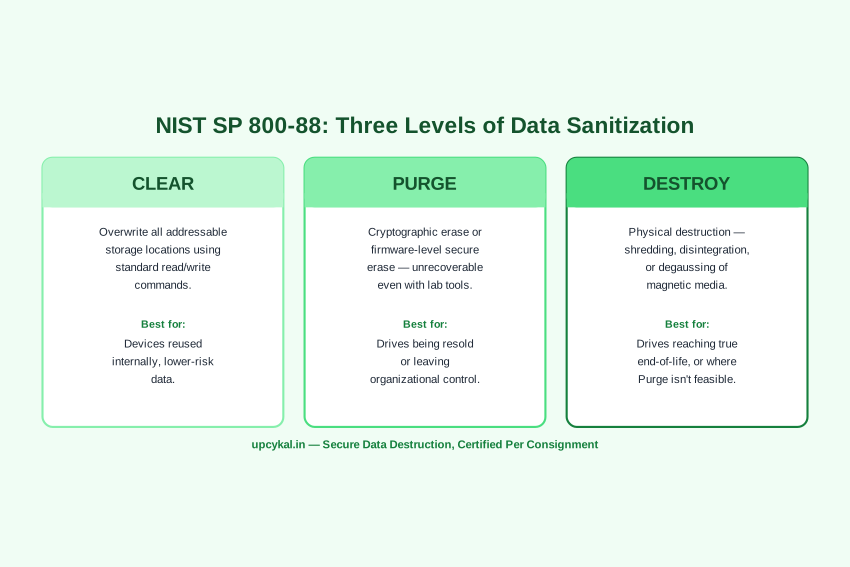
There are three broadly recognized approaches, often referenced via the NIST SP 800-88 framework:
- Clear — using standard read/write commands to overwrite all addressable storage locations (suitable for drives being reused internally, lower risk).
- Purge — using techniques like cryptographic erase or firmware-level secure erase commands that render data unrecoverable even with advanced lab techniques (suitable for drives being resold or leaving organizational control).
- Destroy — physical destruction of the media (shredding, disintegration, degaussing for magnetic media) — used when the drive itself is being scrapped or when Purge isn't feasible.
You may also see DoD 5220.22-M referenced — an older US Department of Defense standard based on multiple-pass overwriting. It's still widely cited in vendor literature, though NIST SP 800-88 is now the more current and widely recognized framework, particularly because it accounts for modern storage types like SSDs, where overwrite-based methods alone aren't always reliable.
Why This Matters More Than Most IT Managers Realize
Retired devices are an unmonitored data exit point
Once a device is flagged for disposal, it often sits in a storeroom, gets handed to a vendor, or is sent for "scrap" — frequently with far less oversight than the device received while in active use. If the drive hasn't been sanitized, every one of those handoffs is a potential point of data leakage.
Regulatory and contractual exposure
Many enterprise contracts — particularly with clients in BFSI, healthcare, or government-adjacent sectors — include explicit data handling and disposal clauses. If an audit asks "how do you prove data was destroyed on equipment disposed of in March," the answer needs to be a document, not "we're pretty sure the vendor handled it."
Reputational risk is disproportionate to the cost of prevention
The cost of proper data sanitization is a tiny fraction of the cost of a single data exposure incident tied to improperly disposed hardware — in remediation cost, regulatory penalty, and the harder-to-quantify damage to client trust.
What a Certificate of Data Destruction Should Actually Contain
A lot of "certificates" in circulation are little more than a generic letter on letterhead. A useful certificate of data destruction should specify:
- The serial numbers / asset tags of the specific devices processed
- The method used (e.g., NIST SP 800-88 Purge via secure erase, or physical destruction)
- The date of processing
- Who performed the destruction and under what authorization
- A way to verify the certificate against the original asset list
If your current process produces a single annual letter that says "we destroyed your data," it's worth asking your vendor whether they can provide per-consignment, asset-level documentation instead. This is the kind of record that holds up in an audit — and that your compliance and legal teams will actually want on file.
The Software Behind the Certificates: BitRaser, Blancco & Certus
A certificate is only as trustworthy as the tool that generated it. At Upcykal, we use licensed versions of industry-recognized erasure software — BitRaser, Blancco, and Certus Erasure — to wipe drives, selecting the tool based on device type (laptop, server, mobile, SSD, or HDD) and the client's compliance requirements.
- BitRaser — NIST-tested via the CFTT Test Suite (jointly developed by NIST and the DHS Science & Technology Directorate) for Purge-level secure erase. Supports 26 erasure methods including NIST 800-88, DoD 3 & 7-pass, and IEEE 2883:2022, and is Common Criteria EAL2 certified. Generates a tamper-proof, asset-level destruction certificate.
- Blancco — Supports 25+ global erasure standards including NIST 800-88, IEEE 2883-2022, ISO 27040, and DoD 5220.22-M, with 13+ certifications from governments and standards bodies worldwide, including ISO 27701 (Privacy Information Management). Every erasure is verified and produces a digitally signed certificate.
- Certus Erasure — Supports 45 erasure methods and standards, including NIST 800-88, IEEE 2883-2022, and ADISA, and is Common Criteria EAL3+ certified — the highest European data erasure certification. Includes a separate verification step that scans the device's bit patterns to confirm erasure was successful.
Using a combination of these tools means coverage across virtually any device type your organization retires, with each erasure independently verifiable against a recognized standard — not just "we ran a wipe and trust us." Every certificate ties back to the specific asset's serial number, the standard applied, and the tool used, so it stands up to audit.
For every drive and laptop we process, you receive a serialized erasure certificate tied to that exact device's serial number — not a single blanket letter covering an entire batch. So when a laptop leaves your premises, you have a one-to-one record showing its data was purged, and your IT team can match every certificate back to the asset it came from. That's the difference between "we're confident it was handled" and having the paperwork to prove it, asset by asset.
Where Data Destruction Fits in the Broader ITAD Process
Secure data destruction isn't a standalone service — it's a stage within a proper IT Asset Disposition (ITAD) process, which also covers asset collection, triage, refurbishment/resale, and certified recycling. We cover the full picture in our guide to ITAD in India for enterprise IT managers.
A Quick Checklist for IT Managers
Before your next round of asset disposal, confirm with your vendor:
- Which standard (NIST SP 800-88, DoD 5220.22-M, or physical destruction) applies to each asset type
- Whether SSDs are handled differently from HDDs (they should be — overwrite methods are less reliable on SSDs)
- Whether you'll receive asset-level certificates, not just a blanket letter
- Whether destruction happens on-site or off-site, and what chain-of-custody looks like in between
How Upcykal Handles This
As part of Upcykal's ITAD process across our network, data-bearing devices go through documented sanitization aligned to recognized standards before any refurbishment, resale, or recycling step — with certificates issued per consignment so your compliance records are audit-ready.
If you'd like your current data destruction process reviewed, or want to see what asset-level certification looks like in practice, reach out to Upcykal or message us on WhatsApp.
Ready to secure your data destruction process?
Upcykal helps enterprises manage secure, compliant data destruction with asset-level certificates.