
Every year, thousands of laptops, desktops, servers, switches, and mobile devices reach end-of-life inside Indian offices. What happens to them next — who handles them, where they go, and what data leaves with them — has quietly become one of the more consequential decisions an IT manager makes. That decision has a name: IT Asset Disposition, or ITAD.
This guide covers what ITAD actually means in the Indian context, why it has become a compliance and security priority in 2026, and what to look for when choosing an ITAD partner in India.
What Is IT Asset Disposition (ITAD)?
IT Asset Disposition is the structured process of retiring IT equipment — laptops, desktops, servers, networking gear, monitors, printers, and mobile devices — in a way that is secure, compliant, and value-recovering. A proper ITAD process typically includes:
- Asset collection and inventory — logging serial numbers, asset tags, and condition at pickup
- Secure data destruction — wiping or physically destroying storage media so no recoverable data leaves your premises
- Testing and grading — determining whether equipment can be refurbished and resold, or must be recycled
- Resale or refurbishment — recovering residual value from working assets
- Certified recycling — environmentally sound processing of equipment that has reached true end-of-life
- Documentation — certificates of data destruction, recycling certificates, and compliance reports for your records
Done well, ITAD is not "throwing away old computers." It's an extension of your IT asset management lifecycle — the final, and arguably highest-risk, stage of it.
Why ITAD Has Become Non-Negotiable for Indian Enterprises
1. Data security risk doesn't end when a device leaves the building
A retired laptop or server still holds whatever was on its drive — financial records, customer data, credentials, internal communications — until that data is properly destroyed. Disposing of equipment through informal local "raddiwalas" or unverified vendors means that data risk leaves your control with zero audit trail. For any company handling client data, this is now as much a contractual and reputational issue as a technical one.
2. EPR and e-waste regulations have real teeth
Under India's E-Waste Management Rules (as amended through 2025–2026), producers and bulk consumers face Extended Producer Responsibility (EPR) obligations, with recycling targets now around 70% of the previous year's sales for IT and consumer electronics categories. Companies are increasingly expected to show that their e-waste was handled by a CPCB-authorized recycler — and to have the paperwork to prove it during audits.
3. ESG reporting needs hard numbers
Sustainability and CSR teams are under pressure to report actual diversion metrics — kilograms of e-waste recycled, percentage diverted from landfill, carbon impact. A proper ITAD partner provides this data in a usable, reportable form; an informal scrap dealer does not.
4. There's recoverable value being left on the table
A meaningful share of retired IT assets — particularly laptops under 4–5 years old — still have resale or component value. Without a structured ITAD process, that value is usually lost entirely, or captured by whoever happens to cart the equipment away.
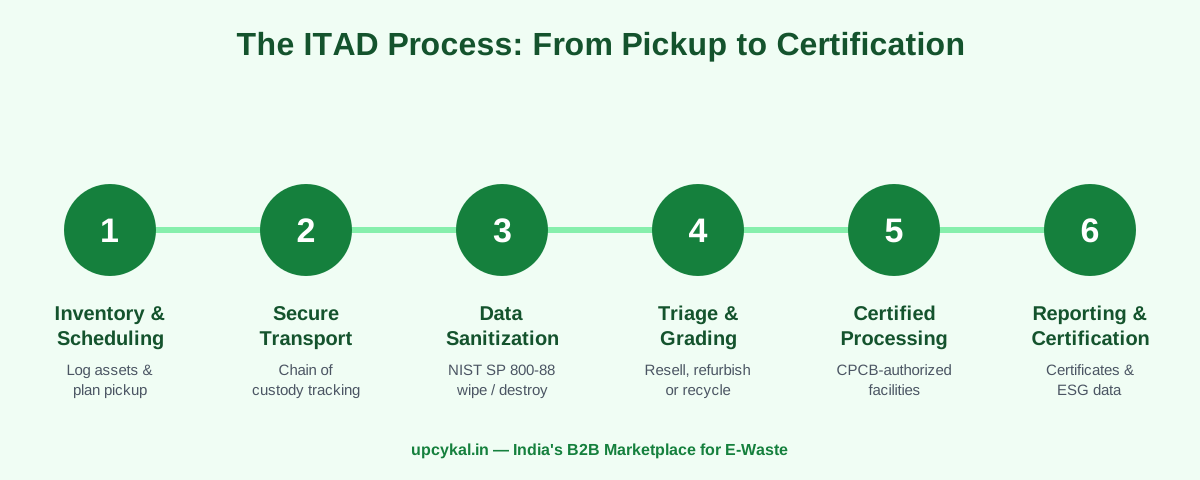
The ITAD Process, Step by Step
- Inventory and scheduling — IT manager shares a list of assets to be retired; pickup is scheduled (ideally aligned to your refresh cycle, not as an afterthought).
- Secure transport and chain of custody — assets are logged and tracked from your premises to the processing facility.
- Data sanitization — storage media is wiped to recognized standards (more on this in our secure data destruction guide) or physically destroyed where required.
- Triage — each asset is assessed: resale/refurbish, component recovery, or material recycling.
- Processing — recyclable units go to authorized recycling facilities for material recovery (metals, plastics, and for batteries, critical materials like lithium, cobalt, and nickel).
- Reporting and certification — you receive certificates of data destruction, recycling certificates, and a summary report for your compliance and ESG files.
The Regulatory Landscape IT Managers Should Know
- E-Waste Management Rules (2022, amended 2025–2026) — set EPR targets, registration requirements for producers, and authorization requirements for recyclers and dismantlers.
- Battery Waste Management (Amendment) Rules, 2025 — strengthened EPR for all battery categories, including lithium-ion, with an increasing focus on recovery of strategic metals and proper handling of li-ion batteries (which carry fire and chemical hazards if mishandled).
- CPCB authorization — recyclers and dismantlers are expected to hold valid Central Pollution Control Board (or State PCB) authorization. Always ask for this before handing over assets.
For a deeper look at how India's EPR framework intersects with global trade compliance (like CBAM), see our earlier post on India's EPR framework as a CBAM advantage.
Choosing the Right ITAD Partner
At minimum, an ITAD partner should be able to show you:
- Valid CPCB/SPCB authorization
- A documented data destruction process aligned to recognized standards
- Transparent reporting — certificates per consignment, not just a generic annual letter
- The ability to handle mixed asset types, including lithium-ion and lead-acid batteries, under one process
- Pickup coverage across the cities where your offices actually are
We'll go deeper on this in our buyer's checklist — but the short version is: treat your ITAD vendor selection with the same diligence you'd apply to any vendor handling sensitive data, because that's exactly what it is.
How Upcykal Fits In
Upcykal is India's B2B marketplace for e-waste, connecting enterprises with verified, compliant ITAD and recycling capacity across ITAD, lithium-ion and lead-acid battery streams — with city coverage including Delhi, Gurgaon, Noida, Bangalore, Mumbai, Pune, Hyderabad, Chennai, Ahmedabad, Kolkata, Chandigarh, and Jaipur.
If your organization is due for an IT asset refresh, or you simply want your disposal process audited against current EPR and data security standards, get in touch with Upcykal — or message us directly on WhatsApp.
Ready to streamline your IT asset disposition?
Upcykal helps enterprises manage secure, compliant IT asset disposal across India.